If one is to say to average Indian -be it in villages or cities, that you can earn millions of rupees by milking the cows, 99 out of 100 will laugh you out.
But for this person it does not matter if 9999 out of 10000 laugh him out. He will speak for hours, show demos, on how to make dairy farming business a profitable one, just to convince that 1 person who shows interest.
There are very meager returns on his investment of time and expertise. It is taking a toll on his health. But he has decided to go for it. He won’t stop. He is a man on mission.
Meet Dr. Shailesh Madane, Bachelor in Veterinary Science and animal husbandry consultant. Borne and brought up in Mumbai. Now he hails from Piliv, a small village in Western Maharashtra, of hardly 9000 strong headcount in Malshiras taluka, Solapur.
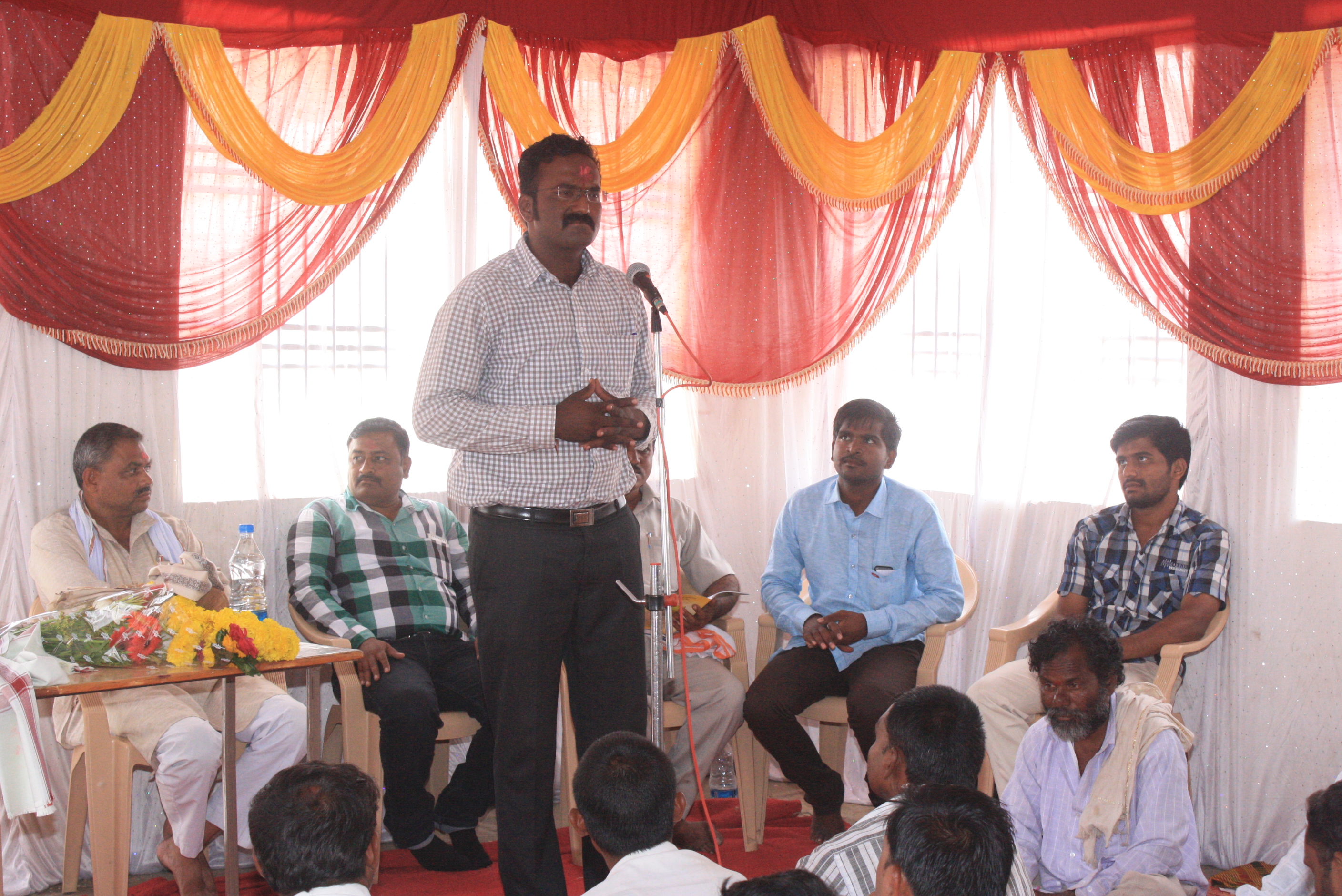
He’s a veterinarian by accident, joined Veterinary college at the insistence of his father.
After completing his college, he has had a successful stint with pharma companies in sales. That’s not a surprise for people who know him. After all, from school days he’s been a social person, talking to all whom he meets with same interest, humility, and genuineness. He’s an excellent orator. Writing, directing and acting in plays, winning trophies has kept his extracurricular resume strong. Some of the skills he acquired and honed in school and colleges are helping him now when he’s touring bits and parts of Maharashtra convincing farmers to adopt modern dairy farming as their main business. He’s the force responsible for the way Dairy Farming in Maharashtra is changing for good.
Dairy farming in India has been traditionally and chronically loss making business – laborious, expensive. With a few exceptions of excellently managed dairy farms – Chitale Milk Dairy in Bhilawadi, Sangli, Bhagyalaxmi Dairy farm in Manchar, near Pune are some of the examples.
Cattle are reared in Maharashtrian villages as a tradition. Catering to milk requirement of own house members. Only additional milk is sold to milk collection centers or dairies. Doodh sankalan kendra (दूध संकलन केंद्र) as referred to in Marathi.
This milk business has been in perennial losses. Average dairy farmer only uses the business to roll the money, to fund for some petty expenses.
Even the milk collection centers are chronically loss making, resorting to fat cutting to keep their profits up. Mostly the collection centers are co-operatives, used more as a political tool rather than to boost milk business in the region they operate.
Traditional Dairy Farming in India – causes of losses
The milk business should ideally be very profitable, advocates Dr. Madane. A farmer starts business with 2 milk producing cows. His livestock strength should go up to 5-10 in 5 years. And every year it should continue to increase.
Instead, the average no. of cows with the Indian dairy farmer has remained only 2-3. And the cow milking is loss making.
There are multiple causes of why the business is in loss.
Extensively lengthy Labor time
Failure in fodder management, high fodder costs
Failure of breeding management or lack of quality breeds
Lack of loose housing or lack of stress free farms
Lack of regular health check-ups
Let’s see all of them one by one below.
Extensively lengthy Labor time
In traditional dairy farming, the farmer has mortgaged his freedom to his milk business, to his cows.
Those of who have livestock cattle in their house or farm, are tied perennially tied up to their dairy farm business. Believe me, it’s worse than 9 to 5 job (stretched to 12 hours) in cities. In 9 to 5 you feel to have surrendered your freedom to your employer.
The schedule of a typical dairy farmer goes like this-
Everyday early morning he’d clean the premises of his dairy farm.
A typical Indian dairy farm would be constructed using hard flooring – tiles or cementing. Lot of efforts go towards keeping it clean from the excreta of cows. If not cleaned, the risk of Mastitis goes up.
Then he’d serve them water and fodder.
The fodder is not stored. So it has to be cut every day or bought from the market. In summers, it is mostly buying from market.
There would be 2-3 such rounds of cleaning, fodder and water. Water and fodder is served to the tied cow at farmer’s convenience.
There would be two-three times during the day, when the cow would be milked.
Also, every once in a while he needs to clean the cows as well. Their skin gets dirty by sitting in the same place as their excreta.
Then he has to travel twice to milk collection centers to sell the milk generated everyday.
Now, if you are intelligent enough, his whole day has been swallowed by this business. He cannot travel anywhere, unless someone else is there to replace him and carry out his dairy farm related tasks during his absence. It is like raising a new borne baby every day.
He cannot use his time to generate money making ideas. Cannot dedicate his time towards other productive activities. And not to say the time cost, labor cost of his own is also non-productive.
This was okay if the milk business itself was extremely productive. He could hire a laborer and pay him some salary and work with reduced profit, giving his time away to other activities or increasing the milk business itself.
But it’s not. Traditional milk business in India, even after such dedicated hard work put in by the farmer does not generate enough money even to cover costs.
Why ? We’ll see it later in the article.
Dr. Shailesh Madane’s teachings are oriented towards reducing this labor time in dairy farming.
The ideal dairy farm or PowerGotha as referred to by Dr. Madane, requires only 1-2 hours of work everyday and can be outsourced.
How ? We’ll see it later.
Failure of fodder management, high fodder costs
If properly managed, the fodder costs should be around 50-60% of the milk rate received by farmer by selling his milk daily.
However, milk business being carried out the way it is, does not enjoy this luxury.
When the rain gods are happy, during monsoons and in winter, there’s plenty of green fodder available in the fields as well as the market. That’s cheap fodder and healthy fodder for cows. The cows are happy, the farmer is happy.
It keeps the help of milk producing cows at the top level. And the volume of milk is higher during these times.
But the scenes are different as summer approaches. The green fodder vanishes. The cows are presented with dry fodder, which is not bad but it does not help in volume of milk produced. The milk volume goes down.
Also, due to failure of irrigation policies in Maharashtra, almost every year has been a drought like in many areas.
This pushes the cost of fodder to unmanageable levels. Unlike the opportunity costs of his continuous labor we saw above, these costs are directly felt by the farmer.
Many of the farmers are unable to cope up here. They are either forced to sell the cows or to send them in fodder camps.
Those who continue with the milk business, continue to raise 1-2 cows only. And it is mainly to sustain own need of milk and not to sell the milk for commercial benefit.
Failure of Breeding Management – Lack of Quality Breeding
Traditionally the breeding is carried out using bulls in the village or in nearby villages. No records are kept.
As modern ways are adopted, with reach of veterinarians in remote villages also, artificial insemination methods, using stored sperms of quality bulls are used to breed cows. Still no records are kept.
Therefore, often the cow and her lineage below is impregnated by the same bull.
Result : In-breeding.
Cows thus produced have deformities, they fall ill very quickly and gradually the milk volume goes down. Some cows become infertile. They never produce milk.
There’s dearth of education in this aspect of dairy farming. People have no knowledge. They know it is harmful for humans to marry within relations, but fail to recognize this fact when it comes to the cows.
Producing quality cows, bulls through breeding is also a part of revenue generating sources of the milk business. Failure of breeding management puts another nail in the coffin.
Lack of Loose Housing – Lack of Stress Free Dairy Farms
As average Indian would have envisage, the cows in the dairy farm are always tied on both sides with big ropes to a pillar or something. And they actually are!
Traditional dairy business knows no modern thing. The cows are perennially tied in the farm shed. They sit and stand in the same place 24 hours.
With some exceptions only for water feeding, or eating grass in the fields they are liberated.
Absolutely no freedom. Whether the cows are sleeping, eating, drinking water, standing, sitting, urinating or excreting.
This puts the cows under lot of stress. It takes toll on their health.
If the farm premises, specially where the cows are sitting, is not cleaned up regularly, it exposes the cows to risk of infections, diseases and puts the milk business in danger.
Overall it results in reduction of milk volume, quality of milk, and reduces health of cows.
Lack of regular health check-ups
Modern or traditional dairy farm, even otherwise also, requires regular health check-ups. Check-up of cow health as well as the dairy farm itself.
This check-up needs to be carried out for possibility of fungal infections, bacterial infections, farm temperature, cleanliness etc.
Now, in traditional system there’s no concept of health check-up.
Only when a cow is visibly ill, she stops producing milk, becomes, infertile, gets infected, udder illness, the farmer then rushes to see the savior, the doctor, the veterinarian.
Result: Frequent illness, diseases, failed pregnancies, reduction in milk volume, loss of revenue.
Loss overall.
Doomsday.
Solution
Is there a solution to above limitations ?
Is it viable economically ?
Is it easy to implement ?
Dr. Madane says, “The answer to all above doubts is a big – YES”
Enter the Modern Way to do Milk Business. Enter PowerGotha – The ideal dairy farm as advocated by Dr. Madane, overcomes all of the shortcomings of traditional dairy farming.
PowerGotha – Modern Dairy Farming
Dr. Madane was in US for few months working at Cornell University, NY in the Quality Milk Production Services Department conducting research on udder diseases.
He learned all the aspects of modern dairy farming there.
Dairy farms in Europe and US are huge. They actually do farming. Thousands of cows being raised.
All the aspects of modernization can be seen there.
Loose Housing – Tick
Stress Free Farms – Tick
Quality Breeding – Tick
Quality green fodder 365 days a year – Tick
Regular Check-ups – A big tick. In fact a lot of research is always being carried out.
Low labor costs, automation – Tick tick tick
All these dairy farms were Power Farms. Power Gothas.
Dr Madane was more than impressed with what he saw there.
Earlier he had spent 3+ years practicing veterinary medicines in his native Piliv. He knew the problems of Maharashtra dairy farmer. And he was aggrieved and sad that the modern techniques have not reached till the tail end of this farmer population.
There was all this knowledge available in India, in Govt schemes and in books, and also with Veterinarians practicing. It was never effectively disseminated. It was never practiced.
Dr. Madane, came back to India with a resolution – to help Maharashtra dairy farmer perform the business the modern way. To help him be in profit. Earn regular cash income.
He was man on mission. He had found a solution to stop the suicides of farmers.
Lectures and Workshops
Dr Madane delivering masterclass in Jalna
After returning to India, Dr. Madane started educating farmers on modern methods to do milk business.
He started from his house, his native village. After all if your own backyard, own village is doing it old way, who will listen to your blah blah.
People imitate success. Rarely do they go for experimenting.
Dr. Madane was initially advocating only two things – Loose housing and Silage making for fodder.
Dr. Madane withdrew a little from his veterinarian practice and started this awareness campaign.
His own dairy business had suffered and started making losses while he was in US. He won’t care.
People were reluctant. He had convince individually. He won’t relent.
There were high costs involved in setting up loose housing if it was done in US way. Dr. Madane devised solution, cost effective, economical methods to construct barricades, compound, shade and mangers. He was genius man on mission. He was now engineering the Power Gotha.
Perseverance paid off. Slowly and steadily there were open housing or loose housing farms taking shape in Piliv.
The farmers started seeing the actual benefits of loose housing and started adopting new methods.
Today there are 40 + loose housing farms in Piliv, almost all constructed following advice and design provided by Dr. Madane.
The milk collection gone up to 40,000 liters – one of the highest in drought hit areas.
The news spread, people started flocking Piliv from surrounding as well as remote areas. Trucks and jeep full of people would visit on weekends or otherwise to see the modern loose housing farms.
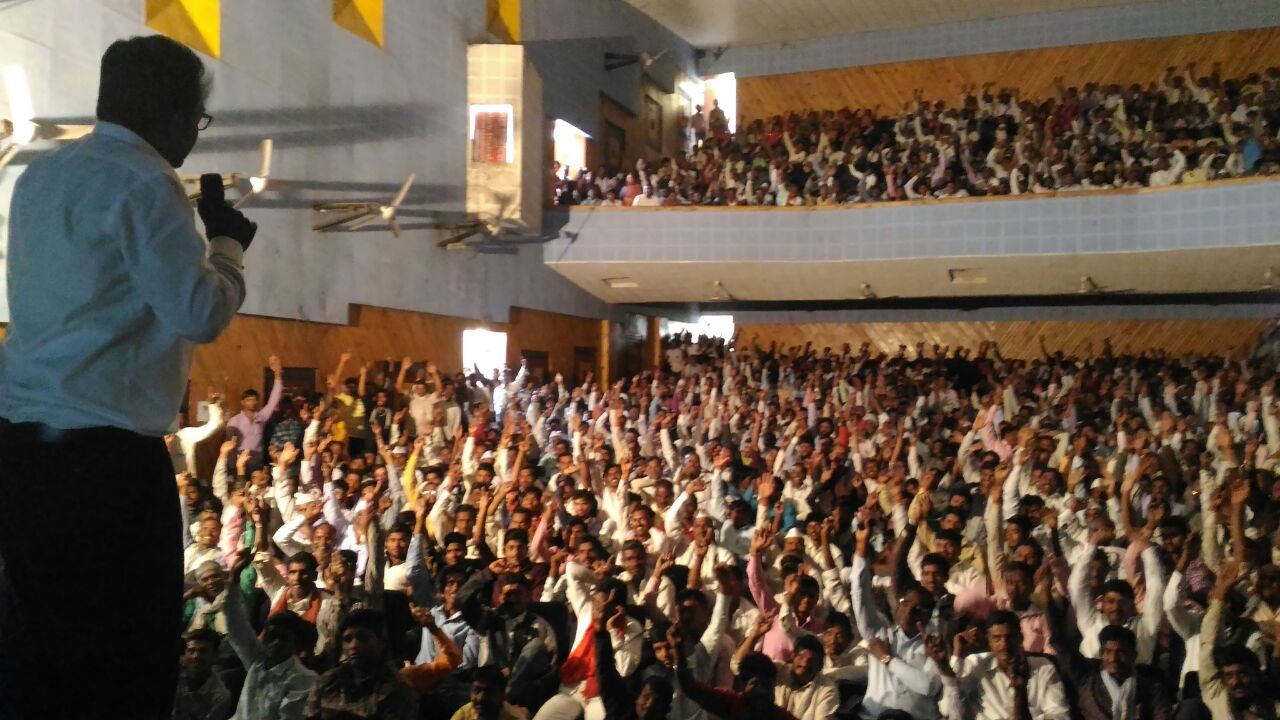
He started getting invitations to speak in educational seminars and workshops. He was an orator. He ruled those workshops. Audience was impressed.
Dr. Madane’s daily schedule got haywire. 16 hours a day won’t suffice the demands of all the activities including his own practice. Family life was affected. Health suffered. He was advised to completely avoid riding bike due to spinal disc problem.
Remote village areas could only be toured with a two wheeler. A solid jerk could cause complete paralysis, he was warned by the doctor.
Again, he won’t care. He was man on mission.
He started touring giving lectures on modern dairy farming, strongly advocating loose housing and silage making to make a profitable milk business. His style was impressive, ingenious. He would talk the language the farmer spoke. He would use local idioms and phrases. He would use laughter to draw attention to the chronic problems of traditional old ways of dairy farming.
Audience enthralled.
Dr. Madane got assistance from Virbac pharma company (one of the biggest in India, sells veterinary medicines). They appointed him as animal husbandry consultant, to train their staff and also to conduct awareness campaigns in the various parts of Maharashtra. Finally he was getting paid for a noble cause. His loss in private veterinary practice was somewhat made for. Still the dairy is making losses.
Dr. Madane toured extensively. Toured all parts of Maharashtra, Vidarbha, Marathwada, Pune, western Maharashtra, Konkan etc. Lectured in 100s of workshops. Tens of thousands of farmers were given preliminary knowledge of modern dairy farming.
A typical audience strength could be anywhere from 50 to 500. It didn’t matter to him if he was speaking in front of only 10 farmers. He spoke with same vigour.
However, the results were not so assuring. Only a handful farmers would go and start modern housing farms in their backyard. The number ranged between only 4-5% of those who would attend the workshop.
Many different villages saw birth of modern farms, but the numbers as compared to the efforts put in by Dr. Madane, were still low.
He needed a bigger stage.
He was genius. He envisaged a bigger formula.
The services of government health officials in the animal husbandry sector who were working at district, taluka and village level were under utilised.
Dr. Madane’s new idea was to educate these health officials, who in turn would go at village level and conduct frequent training of farmers in their work area. He started pursuing the Governement officials with the proposal.
1-2 years passed without any result.
In 2014, the ruling party changed. And also, in meanwhile, his friends had started recognizing his selfless efforts, his social service. He got references and got a chance to present his ideas to ministers and top officials of Animal Husbandry department of Govt of Maharashtra.
He was scared at first. Only 31 year old to show the ministers the formula to help dairy farmers or farmers in total.
He was given 10 minutes to convey the message. He spoke for over an hour. The audience listened.
Ministers were more than impressed.
Instructions were given to implement the suggestions and avail services of Dr. Madane.
The proposal got tied up in red tape for a short while. But the idea being so strong and noble, it was deemed to succeed.
On December 01, 2016, Dr. Madane was invited to provide guidance to District Health Officials of western Maharashtra. These were big officials. Commissioners, asst commissioners. Again, Dr. Madane was scared to speak in front of such a senior audience. Failure to convince these people, would send message to the ministers of ineffectiveness of his teachings.
He carried on nonetheless. The workshop was a success. Many of the attendees were already knowing Dr. Madane for his hard work. Many were happy to see him succeed. Now, he was to cover other areas of Maharashtra.
My friend Vipul Jain, recently made a resolution. It was a stiff target. And boy, he did achieve it with fantastic results.
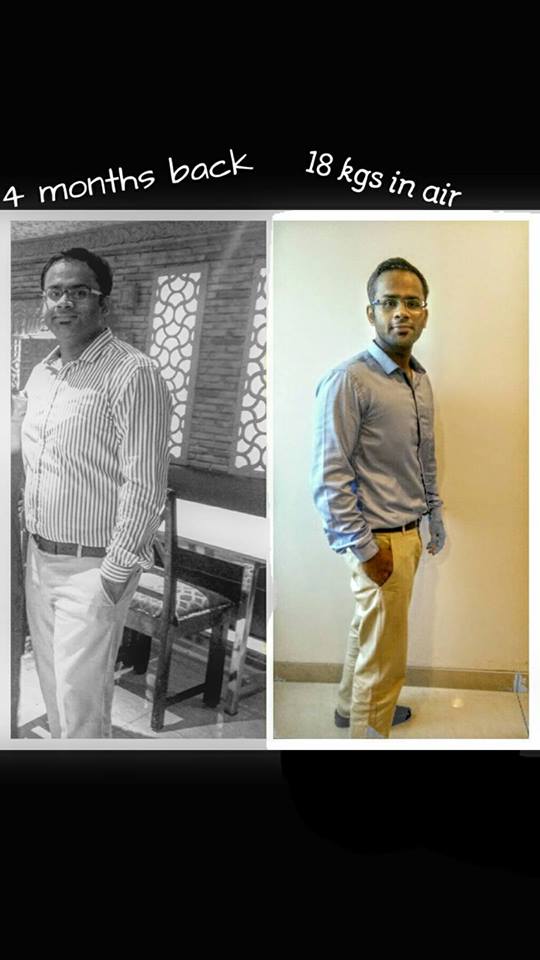
From Fat to Fit, Lose 18 Kgs in 124 days
Almost everyone is always intrigued by weight loss brouhaha. Those who have some extra Kgs to shed believe there’s lot of money involved, some complex methods involved – which is beyond them. This inspiring story proves all of it wrong.
Weight loss is simple and can be achieved by anyone. I personally, am very respectful to those who are able to reduce from fat to fit. How to lose 18 Kgs in 124 days? Vipul Jain explains below –
“Our body is beyond comprehension for most of us. Those who yearn for weight loss find it tough to shed the extra kgs while those on the other end of the spectrum find it difficult to gain the mass. I have always belonged to the former category as my Body Mass Index (BMI) and Fat percentage were always on the upper side. I have tried six times in last 10 years to lower down my weight and in effect my BMI but would always go astray after a couple of months.
In June this year, after all the bashing from my wife and friends for my extreme weight gain (92 kgs precisely) with a BMI of 31.5, I decided to give another shot to my unresolved desire to be fit and healthy. While the basics behind weight loss were already known to me, the game this time was about consistency and determination. I gathered the essential elements and charted out the plan to be dictated by it for achieving the long pending goal.
Essential Items
I gathered three essential items for any weight loss regime which are listed below:-
Weighing Scale
A weighing scale is your best friend in your journey towards a healthy lifestyle. I strongly feel that everyone should buy a scale, manual or digital, for keeping a constant track of their achievement. Your mirror may lie to you during your weight loss drive but a scale never does. It is advisable to check your weight early morning as you wake up. It should be noted that the weight measurements should always be comparable on the daily basis, in the sense that the weight taken in morning should never be compared to the weight noted in evening. It is a known fact that weight readings are always on a higher side in the evening because of the food and water consumption during the day.
Calorie measuring App
If you are serious enough to lose weight, download a calorie measuring app on your smartphone to keep a track of calories you take in during the day. I had tried many such apps but MyFitnessPal wins hands down. It has a database of all the food items which you possibly can eat with correct statistics on their nutritional values. While what you eat daily and what you manually enter would never be exactly similar but the calorie measurement on a regular basis works. More about it explained in subsequent paragraphs of the article.
Pedometer
Running on a lane blindfolded will take you nowhere and starting your weight loss schedule without a pedometer is akin to going blindly on the journey. It is always advisable to have a pedometer or a fitness band to keep track of the steps taken during the day. A basic fitness band like Xiaomi or a pedometer app on your smartphone will be sufficient.
The Process
After gathering the necessary things for weight loss, the next key step is to calculate your daily calorie requirement at your current weight level. There are several websites (MyFitnessPal, BodyBuilding.com, etc) which will measure your current calorie requirement based on some variables like your height, weight, gender, etc. At the start of my journey, my calorie requirement at 91 kgs was roughly 2700 calories with a sedentary lifestyle and close to 3000 calories with a lightly active schedule.
It is a proven and accepted fact that to lose 1 pounds (lbs) of weight in a week, you should take 500 calories lesser than your daily calorie requirement over a week long period. Going by this calculation, if you eat 500 calories lesser daily over 7 days, then your total shortfall would be 3500 calories over a week and you would lose 1 lbs. Multiply it by 4 weeks period and your total loss would be 4 lbs (close to 2 kgs) in a month. While it is generally agreed that a weight loss target of 2-3 kgs over a month is healthy, I had set a challenging target of weight loss of more than 4-5 kgs inn a month. For losing 1 kgs every week (4 kgs over a month), I had to consume less than 1700 net calories daily which seemed herculean at first but was successfully achieved by me over a 4 month long expedition.
Daily Schedule
After keying in my metrics in MyFitnessPal app, my daily calorie target was automatically set to 1600-1700 calories per day. In order to achieve a deficit of 1000 calories daily, I decided to burn off 500 calories in the Gym and the remaining 500 from reduction in my daily food intake. I had also read about the type of food to be eaten and combination of exercises to be done for maintaining a healthy body without taking much toll during the entire effort.
Food Items
I had completely stopped taking sugars (avoiding my 2 cups of daily tea, bakery items, etc) and junk food (bye-bye to McDs, Dominos, Pizzas, etc). Apart from avoiding the obvious choices of fatty food items, I also had read about some healthy food options to include in my daily appetite. Some of the food items which I have been consuming on a daily basis as part of my healthy diet are listed below.
Peanut butter as a substitute for normal butter as it is rich in protein, potassium, good fats (monounsaturated and polyunsaturated) and many other nutrients.
Multigrain or whole wheat brown bread as a substitute for white bread as they are rich in fibre and complex carbs.
Mix flour roti instead of wheat roti made from soya atta, bajra atta and jowar atta.
Green vegetables like ridge gourd, bottle gourd, capsicum, spinach, beans, etc.
Eggs, soya beans, lentils, pulses and paneer to increase my daily protein requirement.
The list of healthy food items is endless but I have shared only some of them which were part of my diet. Various research articles agree on the fact that to lose weight in a rapid manner, the bulk of your diet should come from protein and the least from fats. It is because proteins help in muscle building which is heavier than your stored fats in the body and strong muscles aid in cutting fat in a swift manner. I followed this universally agreed principle and included protein rich foods as mentioned above in my daily calorie intake.
I list down an example of my diet from my daily schedule which I followed rigorously along with a screenshot of the weekly net calories consumption by me (total food eaten-calories burnt in exercise):-
Breakfast- Egg whites (3-4): 60-80 calories, 2 slices brown bread with 1 tbsp peanut butter: 300 calories, Toned Milk with Oats: 350 calories: Total: 750 calories
Lunch: Eating office lunch (one bowl rice, dal, roti, curd) with limiting the calories intake to 800 calories. Occasionally taking soya stuffed roti from home and boiled kala chana.
Dinner: Hot milk with almonds, 1 slice of bread occasionally. Total 400 calories.
I was consuming 2000-2100 calories daily with focus on more protein and lesser fats. There is a concept of ‘Cheat day’ when you are dieting in which you can eat whatever you want on one specific day of the week. Though there is nothing wrong in this, I deliberately had not taken any cheat day for 2 months and continued with my boring diet.
I strongly believe that one of the important reasons for my swift weight loss was cutting down on my dinner for 2-3 months and not having any cheat day in between.
Exercise
Burning 500 calories through exercise was not a simple task either. I read myriad articles on the best combination of exercises, type of exercise, right time of exercise, etc to make the best possible regime to follow over the period. After a careful research, I devised an exercise plan having following salient features:-
Though the best time of exercise is in the morning as your metabolism remains boosted during the entire day, I decided to devote 60-80 minutes daily from my evenings to spend in the gym based on my convenience.
I was not doing only cardio or weight training on a particular day and I instead mixed up the two on a daily basis. While cardio like jogging and cycling are beneficial in reducing the overall body fat, weight training is essential to tone the body and giving it a droolworthy look.
I understood from research articles that doing high intensity exercises in periodic intervals (technically known as HIITs) is the key to burn fat rapidly. Such exercises create a phenomena called EPOC (excess post-exercise oxygen consumption) in your body which means that HIITs create a high deficit of oxygen in the body which keeps burning calories even after your HIITs session. This was experienced by me during my journey as doing a high intensity workout on a particular day without meeting the daily target of burning 500 calories would still not abruptly increase my weight.
For reducing my paunch, I focused on core building exercise like doing sit-ups, crunches, planks and for adding an impetus to weight loss, I added compound exercises (which involve more than 1-2 muscle groups) to my schedule like Squats, Deadlifts and Lunges.
Some Useful Tips
Based on my experiences and leanings from articles over 5 month long period, I am sharing some useful tips which can be emulated in your plan without second thoughts:-
Eat more protein in your daily diet and reduce fat consumption (but do not eliminate). Try to eat Carbs (rice, bread, roti) before evening only and limit your dinner to food items abundant in proteins liked boiled dal and beans. Experts recommend 0.8 to 1.2 gms into your total body weight in kgs of protein daily (example- An 80 kgs person should take 64-100 gms of protein daily). I have been taking more than 80 grams of protein daily to meet the benchmarks.
I reiterate that for an effective weight loss regime, always do compound exercises once or twice a week. It can either be done freehand or with weights as per your convenience.
Drink a glass of warm water with lemon and honey. Lemon detoxify your body and honey lubricates your digestion system.
Find reasons to walk more steps during your day like meeting your friends {and even your bosses :-)} sitting at different floors, taking stairs to reach your workstation/canteen. I keep a target of climbing 8 flight of stairs in our HO (total 192 steps) once a day either in interval or at one stretch.
Try to eat a healthy lunch twice or thrice a week by getting it from home instead of eating oily food in the canteen.
During your cardio sessions, don’t waste time in running at your comfortable pace. A comfortable pace is one at which you can run at a stretch for over 2 minutes.
Sunset looks so beautiful when you are fit..
And I would conclude this article with an important remark, “It’s not only about achieving your set target, it’s also about sustaining what you have achieved’. And trust me, the latter part is the difficult of the two 🙂
It was a fresh wet Sunday morning on 18 September 2016. I ran and completed one of the most dreaded and feared race of my life. The location was Satara, a well-known town in western Maharashtra and the race was called Satara Hill Half Marathon (SHHM).
The Event
Satara Hill Marathon is an annual event started in 2012 and year by year it is getting popular. They have even entered GUINNESS WORLD RECORDS for the category – “Most people in a mountain run – single mountain“. It is so much popular in Mumbai Pune marathon runners that, only for those 2 nights the hotels in Satara due to limited availability charge 3-4 times the normal rate for nightstays.
The race is usually divided into 3-4 events. 21k (21 kms) main half marathon, a 10k (10 kms) event, a 5k run, and 3 kms walk or run for children and elderly.
The Route
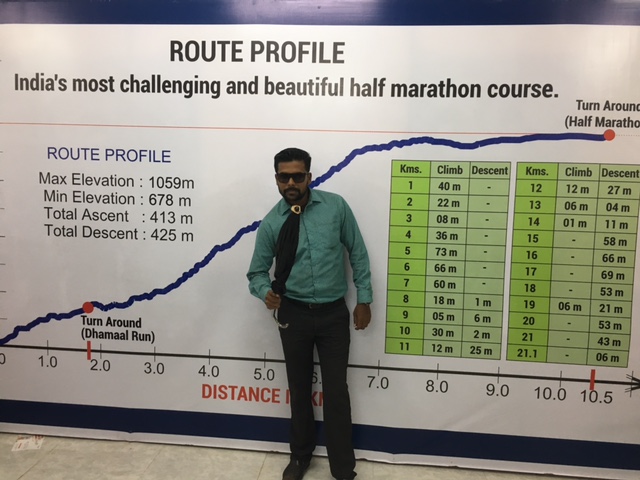
The terrain is extremely tough, with upward climb of approximately 400 meters. It starts at 678 meters from above sea level reaching peak of 1059 meters at halfway level and then downhill U-turn. Those of you who are regular runners or are trekkers, will understand the difference between flat surface running and hill climb. For 21k you have to climb up 10.5 kms and then climb down to complete the race. In 10k race, it’s just 5k up and 5k down.
Satara Hill Marathon Route Profile
Here’s what Dr Sandeep (Race director, one of the founders of SHHM) has to say about the difficulty of the terrain.
It starts at 678m above sea level, climbing starts right from the word go, and it’s all uphill until the halfway mark at the turnaround.
From then onwards, it’s all the way downhill to the finishing point. The course is a really testing one, definitely a challenging one for even veteran runners, not to mention beginners, who should feel super proud, if they manage to do this one as their first half marathon !!!
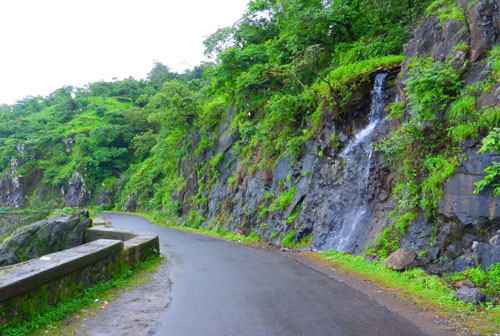
The terrain is also very beautiful. You get to see the whole Satara city from the race route and a magnificent sunrise can also be witnessed during the morning run.
Satara Hill marathon Route picSHHM pic 2SHHM pic 2
You nearly touch the heritage Kaas Plateau of beautiful flowers. Especially since the race happens every year in August- September, it’s the rainy season and clouds are helpful in keeping away the sun. Rain drenches you. And the scenery enthralls you.
My Fears
I used to run 10k every year for precisely this reason. I wanted to experience a thrilling race and I didn’t feel confident about 21km climb up. In fact, I dreaded the climb up. Never felt confident that my heart and legs will endure 10kms run up the hill if I run 21K race.
This year however the organizers decided to do away with 10k event itself and the flagship 21k race remained the main event. I had only two options. First was, forget about the excitement, thrill of a mountain race. Second, participate in 21kms race and try and overcome the biggest fear I had. I chose the second. The urge of new experience and excitement took over the fear of the uphill climb and endurance of the race.
There’s a reason why I lacked confidence. I have run 21k half marathon races earlier also. Which includes, 3-4 times Standard Chartered Mumbai Marathon (SCMM) and 1-2 other places. But such events happen in December onwards and in good weather. You get to prepare for the race. For Satara race however, due to Mumbai monsoons, it is difficult to regularly practice running long distances. Especially for a lazy person like me, there’s one more excuse of not to practice when it rains. Also, the climb up, requires hill training. Your knees, lungs and heart are not so well conditioned for a mountain race if you are used to practice on flat surface. More difficult in the case when you are a desk worker like me- who goes to office 5 days a week and just sits in front of a computer.
So much stacked against me… So, How did I do it ???
Preparations: Required vs. What I actually did.
Any 21k race requires good deal of long distance running practice. And in addition to running multiple tens of kilometres regularly one also needs to do strength training for legs and core.
In one of my previous half marathons, I had injured my knee ligament. After, the race I had visited a physiotherapist friend. While treating me, she asked, how you prepare for marathons. I said, “I run”.
“And, What about strength training for legs?”
“Huh???” I was flummoxed. “I also do Yoga twice a week”
“No! Not enough. You need to also do strength training like squats, lunges, core training etc. Otherwise you’ll end up injuring different muscles every time.”
I was enlightened. I was given different exercises while I was treated. But I received a lesson. I incorporated some of the leg exercises in my routine there onwards.
But, this hill marathon stuff was even tougher, so to say, at least to my mind.
Here’s how I prepared.
I had just recently married in April first week. I went to Greece in May, and then Eastern Europe in July-August 2016. And then Monsoon rains were at the peak in Mumbai during almost the whole season from July to September.
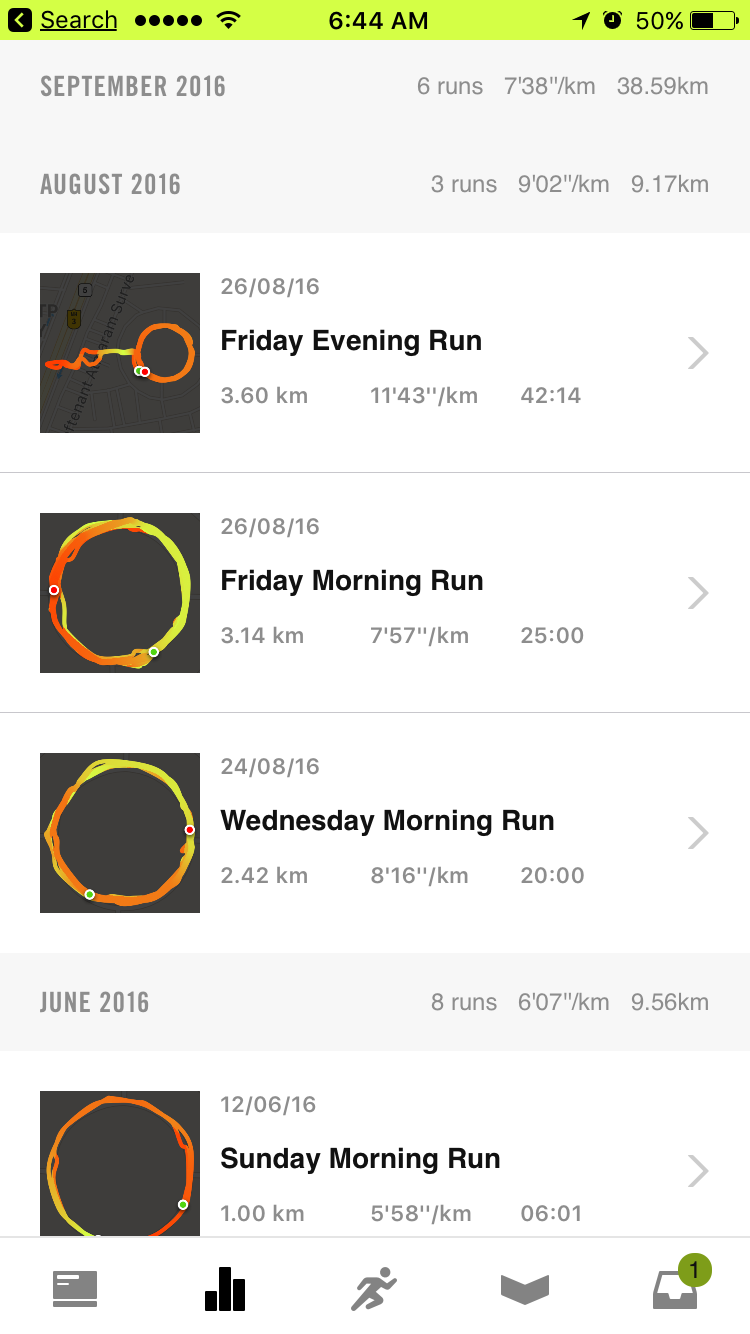
So there was no running, at least in the name of formal marathon practice since early March till the race day on 18th September. I had barely managed to run 54 kms in these 6 months. In the days preceding the race, I managed to clock 12-13 kms, which included couple of 5k runs.
And, what about hill training then? Well, even here, there was none of it. I ran on flat surface just in front of my house.
To alleviate my fears of increase heart rate due to hill climb, I decided to prepare for it in a different way. I started to take stairs in office. I work on 6th floor.
Since late August 2016, I avoided lift in office. I averaged 15-20 stories every day in office. This, I continued for 20-25 days, till the raceday on September 18th.
I don’t know how much it really helped in actual half marathon that Sunday. But, psychologically at least I was self-patting for preparing in a novel way. I believed it helped my knees and heart rate training. :p
Health Challenge
I suffer from Ankylosing Spondylitis. It affects the spine and causes backaches, rib-cage pain and heavy morning stiffness. I am actually off-medication as I have controlled it through mental conditioning and yoga practice.
But, there are occasional flare-ups. For 1-2 weeks, it will give me pains and cause stiffness. For which, I take mild painkillers (NSAIDs). Here also it started in August and continued in September till the race day. The stiffness in back caused back muscles to go into Spasms. So, I was suffering from chronic stiffness and pains in the back and also fighting spasms, which caused me difficulties even to turn while sleeping.
Travel
I was to stay at a friend’s place at Satara. In fact reaching Satara, a day before was also a worry. Satara is 250 kms from Mumbai. I had not got in touch with any race participant, so that I couldn’t hope for any carpool. Choice then remained, public transport or own car. Taking own car, I feared if any injury would land me difficulties in driving the next day back to Mumbai. Even my backache might aggravate by the long drive. Public transport was to take longer time and arduous.
Fortunately, an old friend from nearby Satara called me up and informed he was in Mumbai and travelling towards Satara the next day. He agreed to drive the car. I was relieved.
Raceday Thoughts
I reached Satara, but I was extremely tensed about completing the 21k race. How do I complete the marathon? The backache and spasms were playing on my mind. I had taken mild painkillers to alleviate pain.
SHHM Event Expo Enthusiasm
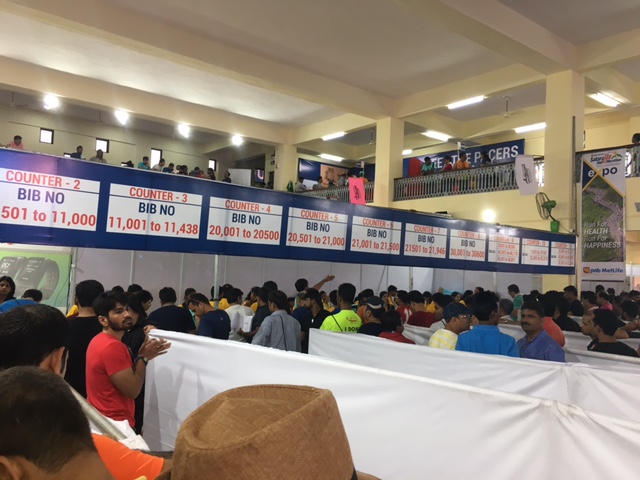
It was raining heavily the whole Saturday, while I was travelling as well as while I collected bib and T shirt from the event Expo.
I run with my iPhone to track the run. I feared the rains might force me not to take the phone with me. I also feared in heavy rains I might not be able to run.
But at the expo, seeing the exuberance of the crowd, the elderly and the ladies equally participating enthusiastically, I decided I had to complete the race anyhow. I will run slowly. I’ll walk. I’ll take more than 3 hours for 21kms but I will surely complete the race.
Race
I woke up early morning on Sunday. The backache was nearly relieved.
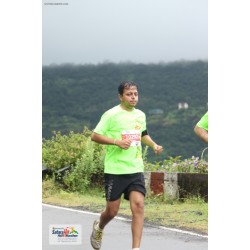
I reached race venue. There were so many participants, thousands of them. It was drizzling, extremely light. I used armband to protect my iPhone from rains.
Race started. I kept telling myself to give it everything. I planned to run hard on flat surfaces and go slow or walk on uphill route.
Climb up
There wasn’t much difficulty to complete first 2-3 kms. You move with the enthusiasm of the runners’ crowd. You use up fresh legs and energy.
After 3 kms the real steep climb started. I kept telling myself to not stop. I walked, then ran for few meters and then again I walked. Plenty of locals had gathered around the track to cheer up the crowd. They had put up music bands, dhol, DJs, speakers. Motivating songs like chak de and Wo sikandar hi doston were playing.
Meanwhile 1 hr 45 mins, 2 hr buses went by. I was tracking 2:15, 2:30 buses by half time. (buses are timed runners who are sure to complete the run on advertised times and they carry placards showing the bus time. You need to follow and match their pace if you want to finish within such times. )
I was trying to complete halfway 10k mark by 1 hr 30 minutes. I drew spirit from the runners, the landscape, the cheering of the crowd. I drank Enerzal or water every 2-3 kms to keep myself hydrated. I was able to reach halfway and take a U turn by 1 hr 35 mins. I was walking real slow by this time. And now, the easier part of the race – downhill 10 kms remained. By now, I was congratulating myself for completing the race.
At the about turn, I made up my mind to make most of climb down. I ran the remaining race with maximum effort I could manage with the remaining energy, walking only for few meters in between.
I managed to complete the race in 2 hr 46 minutes.
I was exhausted. I was elated.
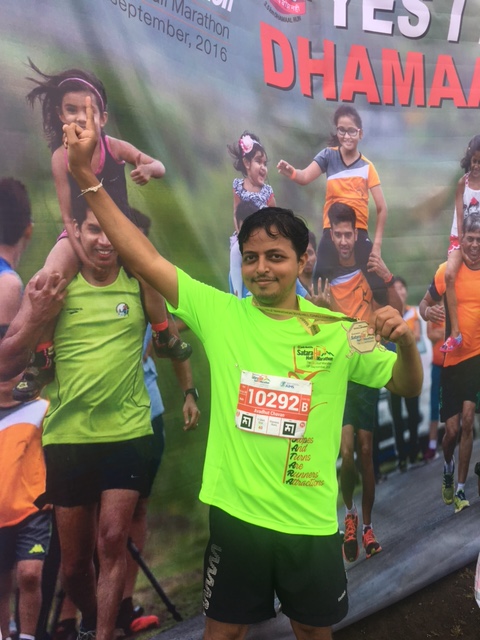
It was time for after race pics with medal.
I had just completed one of the hardest races of my life. And there was no injury. The timing was good too. My best time on flat surfaces was 2 hr 15 minutes. 2 hr 46 minutes was much much quicker than what I had envisaged going into the race.
Advisory to beginners: What to do and what not to do during hill marathon
Though I completed successfully with minimal preparation, I still think you should never participate in marathons without preparations.
Prepare well. For hill marathons, practice on uphill and downhill terrain before the race.
Use stairs whenever you can.
Train well your legs and core. I had been training squats and push ups regularly. There was no injury this time and I was able to drive down 250 kms to Mumbai after the race.
Keep a track of your practice.
Do not sip away all your energy in the beginning of the race. Divide the effort equally.
Use the downhill path to max out your effort. It will improve your overall timings.
Do not give up on any hard target without effort.
Treat yourself with a grand reward for completion of hard targets
p.s. Edit: Be careful to practice downhill before implementing in race, it may lead to injury if you are maxing out beyond your body capacity.